
BEFORE YOU SAY IT...

Three Questions That Could Change Our Christian Relationships
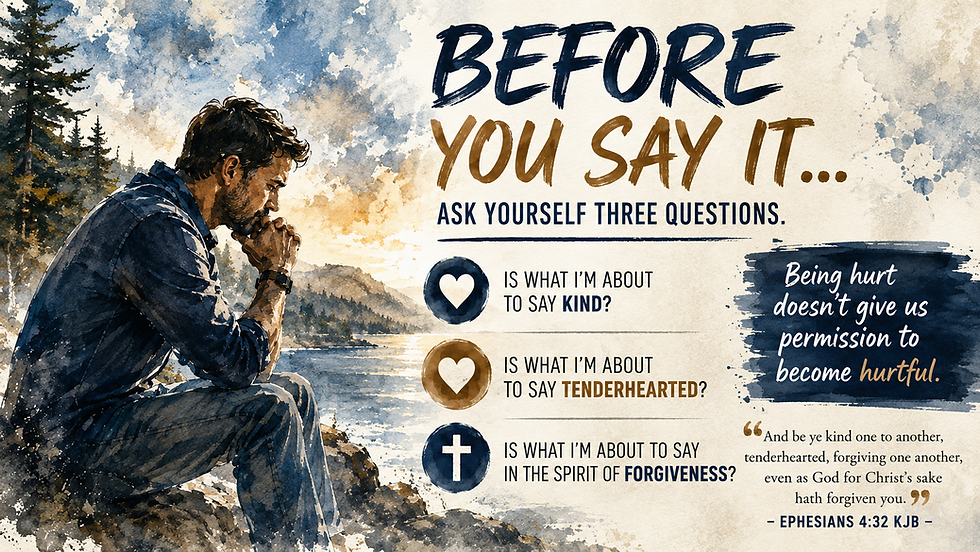
“And be ye kind one to another, tenderhearted, forgiving one another, even as God for Christ's sake hath forgiven you.” — Ephesians 4:32
Some of the deepest hurts we experience do not come from strangers.
They come from people we love.
Husbands and wives. Family members. Close friends. Church members. Brothers and sisters in Christ.
The closer someone is to our heart, the greater their ability to hurt it.
And when we have been hurt, disappointed, misunderstood, or treated unfairly, our natural reaction is often to respond out of that hurt.
That is when Ephesians 4:32 becomes especially important.
Before I speak…
Before I send that message…
Before I answer while angry…
Before I remind someone of what they did…
Before I say something simply because I want them to understand how badly they hurt me…
Perhaps I should stop and ask myself three questions:
Is what I am about to say KIND?
Is what I am about to say TENDERHEARTED?
Is what I am about to say in the SPIRIT OF FORGIVENESS?
Those three questions can go a long way toward protecting the Christian relationships God has given us.
1. IS WHAT I AM ABOUT TO SAY KIND?
“And be ye kind one to another…”
Notice that kindness is not merely suggested.
God says, “Be ye kind.”
That command does not disappear because I have been hurt.
I may have a legitimate complaint.
I may have been misunderstood.
Someone may genuinely have wronged me.
I may even be completely right about what happened.
But being right does not give me permission to be cruel.
Sometimes we justify harsh words by saying:
“But it's true.”
Truth matters. But the Bible tells us to be:
“…speaking the truth in love…” — Ephesians 4:15
Truth does not cease being truth when it is spoken kindly.
And kindness does not require us to ignore truth.
We can confront something that is wrong without deliberately trying to wound the person who did it.
So before I speak, I should ask:
Is what I am about to say kind?
Not:
Does this person deserve kindness right now?
God did not say:
Be kind when the other person deserves it.
He simply said:
“Be ye kind one to another.”
2. IS WHAT I AM ABOUT TO SAY TENDERHEARTED?
“…tenderhearted…”
There is a difference between having something on your heart and throwing it at someone else's heart.
A tender heart considers the person on the other side of the conversation.
How will these words affect them?
Am I trying to help them—or hurt them?
Am I trying to restore the relationship—or win the argument?
Am I speaking because something genuinely needs to be resolved, or because I want them to feel some of the pain I am feeling?
That becomes especially important when we have been hurt.
Because hurt has a way of changing the way we speak.
When our heart is wounded, we can begin speaking from the wound instead of speaking from the Spirit of Christ.
Someone raises their voice, so we raise ours.
Someone says something hurtful, so we search for something more hurtful.
Someone reminds us of one failure, so we remind them of five.
Someone reaches into yesterday, so we reach even further into the past.
Before long, two people who love each other are no longer trying to solve a problem.
They are trying to win a battle.
The Bible says:
“A soft answer turneth away wrath: but grievous words stir up anger.” — Proverbs 15:1
Tenderheartedness does not mean weakness.
It means that even when my own heart is hurting, I still care about yours.
So I ask:
Is what I am about to say tenderhearted?
3. IS WHAT I AM ABOUT TO SAY IN THE SPIRIT OF FORGIVENESS?

“…forgiving one another…”
This may be the hardest question of all.
Especially when the wound is real.
Forgiveness does not mean pretending something did not happen.
It does not mean saying that wrong behaviour was acceptable.
It does not mean that we cannot tell someone:
“What you said hurt me.”
It does not mean that difficult issues should never be discussed.
And it does not mean that necessary boundaries can never be established.
But there is a tremendous difference between discussing something for the purpose of healing and bringing it up for the purpose of hurting.
Sometimes our words reveal that although we said we forgave something, we are still carrying the ammunition.
Then another disagreement comes.
And suddenly we reach into the past:
“Remember when you…”
“You always…”
“You never…”
“What about what you did?”
Past failures become weapons for present arguments.
But forgiveness cannot flourish while we continually keep old offences loaded and ready to fire.
Forgiveness does not mean there was no wound.
Forgiveness means I refuse to use the wound as a weapon.
So before I speak, I need to ask:
Is what I am about to say in the spirit of forgiveness?
Am I seeking reconciliation?
Am I seeking understanding?
Am I seeking restoration?
Or am I trying to make sure they hurt because I hurt?
BEING HURT DOES NOT GIVE US PERMISSION TO BECOME HURTFUL
This may be one of the hardest truths in Christian relationships.
Someone else's wrong behaviour does not justify wrong behaviour from me.
The Bible says:
“Recompense to no man evil for evil.” — Romans 12:17
And:
“Be not overcome of evil, but overcome evil with good.” — Romans 12:21
There is tremendous wisdom in refusing to allow another person's behaviour to determine the spirit of our response.
I can say:
“That hurt me.”
…and still be kind.
I can say:
“We need to talk about what happened.”
…and still be tenderhearted.
I can say:
“What happened was wrong.”
…and still speak in the spirit of forgiveness.
Kindness does not mean silence.
Tenderheartedness does not mean weakness.
Forgiveness does not mean pretending there was never an offence.
It means that even while dealing honestly with the hurt, I refuse to become hurtful myself.
THE STANDARD IS CHRIST
The most humbling part of Ephesians 4:32 may be the last few words:
“…even as God for Christ's sake hath forgiven you.”
God does not tell us to measure our forgiveness by how well the other person has treated us.
He points us toward how He has treated us.
Think about how much God has forgiven us.
Think about how patient He has been with us.
Think about how many times we have failed Him.
Think about how often we have needed His mercy.
And yet He has shown us grace.
That changes the question.
Instead of asking:
“What does this person deserve from me?”
Perhaps I should ask:
“What have I received from Christ?”
Mercy.
Grace.
Kindness.
Compassion.
Forgiveness.
And those who have received grace should become people who give grace.
THIS DOES NOT MEAN WE NEVER CONFRONT WRONG
Biblical kindness does not mean pretending everything is okay when it isn't.
Love sometimes requires difficult conversations.
Jesus confronted sin.
Paul rebuked error.
Scripture commands believers to deal with offences.
But there is a world of difference between confrontation for restoration and confrontation for retaliation.
The Bible says:
“Brethren, if a man be overtaken in a fault, ye which are spiritual, restore such an one in the spirit of meekness…” — Galatians 6:1
Notice the goal:
RESTORE.
And notice the spirit:
MEEKNESS.
If my goal is simply to defeat the other person, embarrass them, punish them, make them hurt, or prove that I am right, something has already gone wrong in my heart.
The goal of a difficult Christian conversation should not be:
How can I win?
It should be:
How can we make this right?
THREE QUESTIONS BEFORE WE RESPOND
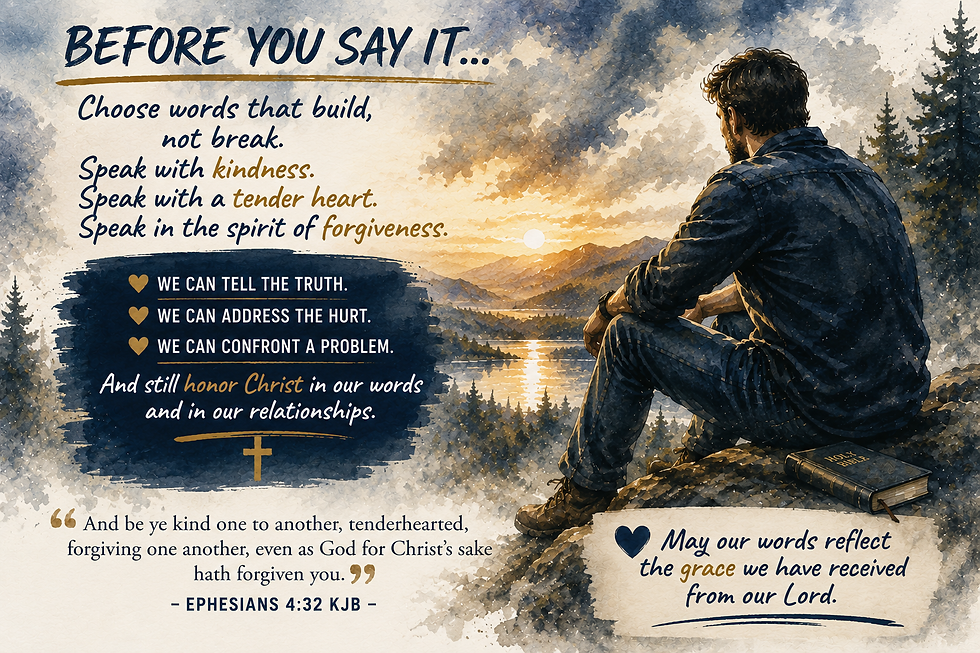
Imagine what could happen in our marriages, families, friendships, and churches if we learned to stop before responding in anger and ask:
Is what I'm about to say KIND?
Is what I'm about to say TENDERHEARTED?
Is what I'm about to say in the SPIRIT OF FORGIVENESS?
If the answer is no, perhaps it does not need to be said that way.
Maybe the issue still needs to be addressed.
Maybe the conversation still needs to happen.
But perhaps it needs to wait until our heart is prepared to have it in the right spirit.
Because once words leave our mouths, we cannot call them back.
“Death and life are in the power of the tongue…” — Proverbs 18:21
Words can tear down years of trust in minutes.
But words can also heal.
They can reassure.
They can restore.
They can communicate:
I am hurt, but I still love you.
We disagree, but I am not your enemy.
What happened matters, but so does our relationship.
We need to deal with this, but I don't want to destroy you in the process.
I want restoration more than I want victory.
Sometimes those three questions might save us from saying something in five seconds that takes five years to repair.
AND IT MUST BEGIN WITH ME
Perhaps this is the most important part.
It is easy to read Ephesians 4:32 and immediately think about somebody else.
They need to be kinder to me.
They need to care about my feelings.
They need to forgive me.
But before I use this verse to examine somebody else's behaviour, I need to allow it to examine mine.
God says:
“Be YE kind…”
Before I demand kindness, am I giving it?
Before I ask someone to care about my heart, am I tender toward theirs?
Before I ask them to forgive my failures, am I still keeping a record of theirs?
And when I have been hurt, am I allowing my pain to determine how I treat them?
Christian relationships would change dramatically if we stopped asking:
“Who is right?”
long enough to ask:
“How can I respond like Christ?”
Sometimes we can win the argument and lose something far more valuable.
The goal should not simply be to prove our point.
The goal should be to love one another in a way that honours Christ.
So especially when you have been hurt…
Before you say it…
Before you send it…
Before you answer in anger…
Before you bring up the past one more time…
Ask yourself:
Is it KIND?
Is it TENDERHEARTED?
Is it in the SPIRIT OF FORGIVENESS?
Because being hurt does not give us permission to become hurtful.
And sometimes the first heart that God wants to deal with in a difficult relationship is not the heart across from us.
It is our own.
“And be ye kind one to another, tenderhearted, forgiving one another, even as God for Christ's sake hath forgiven you.” — Ephesians 4:32


Comments