
Reconciling Acts 2:16 Dispensationally

But This Is That: Understanding Peter's Statement At Pentecost
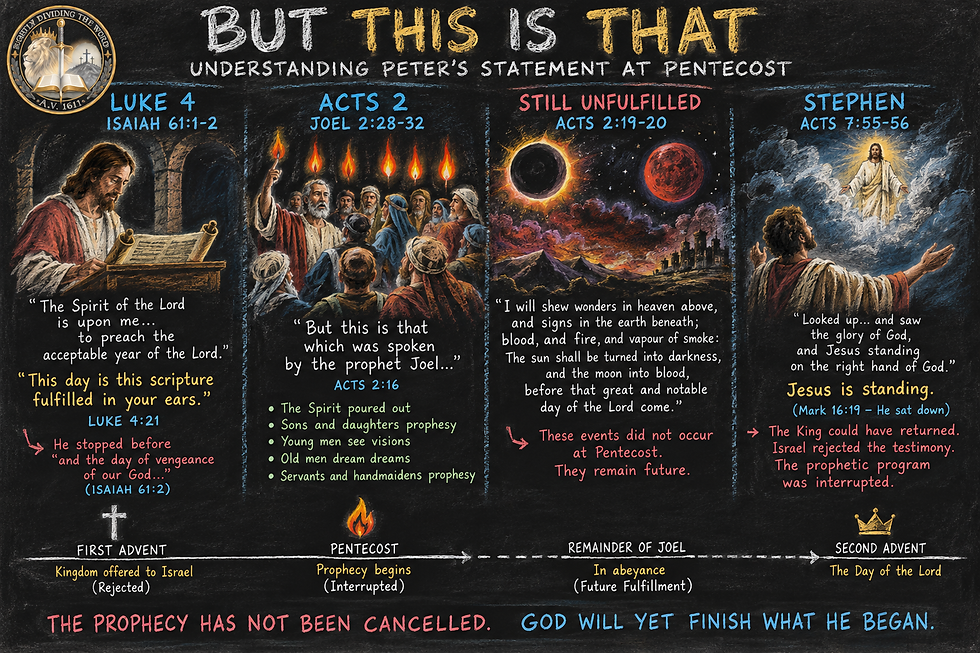
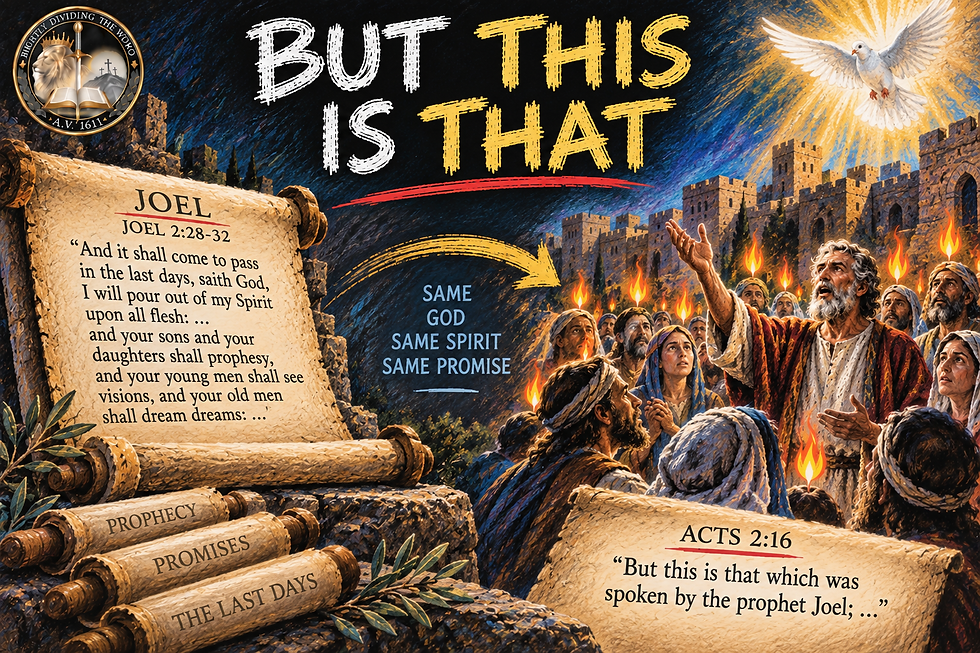
"But this is that which was spoken by the prophet Joel; And it shall come to pass in the last days, saith God, I will pour out of my Spirit upon all flesh: and your sons and your daughters shall prophesy, and your young men shall see visions, and your old men shall dream dreams: And on my servants and on my handmaidens I will pour out in those days of my Spirit; and they shall prophesy: And I will shew wonders in heaven above, and signs in the earth beneath; blood, and fire, and vapour of smoke: The sun shall be turned into darkness, and the moon into blood, before that great and notable day of the Lord come:” Acts 2:16–20
I am going to make what may seem like an outlandish statement, especially for us Bible Believers.
For clarification, I have read Dr. Peter Ruckman’s commentary and Reference Bible notes on these verses, as well as the works of Gaebelein, Bullinger, and Scofield. Let me say emphatically that I do not consider myself a more able expositor than any of these men. I am simply a Bible student attempting to believe what the Book says and understand the passage as it stands.
Nothing written here is intended to be disrespectful toward these men, all of whom I hold in high regard. Brethren can disagree over difficult passages of Scripture while still maintaining Christian charity toward one another. We ought to agree without compromise that salvation in this present age is by grace through faith, plus nothing and minus nothing. Beyond that, one of the great tests of Christian character is the grace with which we treat brethren with whom we disagree.
With that understood, there has always been something about the traditional explanations of Acts 2:16–20 that has never completely satisfied me.
Though I find myself closer to Scofield’s comments on this particular passage, even his explanation leaves me with the fundamental question raised by Peter’s own words:
Was this, as Peter plainly stated, “that which was spoken by the prophet Joel”?
I believe the answer is yes—but not yet in its entirety.
WAS PETER WRONG?

The first thing that occurred to me while considering this passage was that the Holy Spirit, in His divine foreknowledge, did not exclude Peter’s statement from the inspired record.
If Peter was simply mistaken when he declared,
“This is that which was spoken by the prophet Joel,”
why did the Holy Ghost preserve the statement in Scripture without qualification or correction?
Luke could simply have recorded the events of Pentecost without including Peter’s identification of them with Joel’s prophecy. Yet the statement remains in the Text.
That deserves serious consideration.
If we believe, as the Scripture says, that:
“Holy men of God spake as they were moved by the Holy Ghost,”
then we ought to be very careful before concluding that Peter’s words, as preserved for us in our
King James Bible, were simply wrong.
This becomes even more significant when we remember what Acts has already told us:
Acts 2:4:“And they were all filled with the Holy Ghost, and began to speak with other tongues, as the Spirit gave them utterance.”
Peter is standing among men who have just been filled with the Holy Ghost, speaking “as the Spirit gave them utterance.” Yet we are expected to believe that Peter immediately stands before Israel and completely misidentifies the very spiritual manifestation taking place before him?
That has always been difficult for me to accept.
Furthermore, nowhere later in Scripture do we find Peter’s statement corrected, amended, or repudiated. There is no passage saying, in effect, Peter misunderstood Joel.
That leads me to believe that Peter’s statement was factual.
But that does not mean everything Joel prophesied was fulfilled on the day of Pentecost.
And therein lies the distinction.
SOME OF JOEL CLEARLY REMAINS UNFULFILLED

If we take Acts 2:16–20 in its entirety, an important clue to its proper interpretation immediately emerges.
Regardless of our particular position on Acts 2, we should all be able to agree that verses 19 and 20 were not fulfilled at Pentecost:
“And I will shew wonders in heaven above, and signs in the earth beneath; blood, and fire, and vapour of smoke: The sun shall be turned into darkness, and the moon into blood, before that great and notable day of the Lord come:”
Those events plainly did not occur in Acts 2.
This is undoubtedly one reason many expositors conclude that Joel’s prophecy was not fulfilled at Pentecost at all.
But does the fact that all of the prophecy was not fulfilled necessarily mean that none of it could have been fulfilled?
I do not believe it does.
And Scripture itself gives us an excellent example.
“THIS DAY IS THIS SCRIPTURE FULFILLED”
Those of us who rightly divide the word of truth recognize that during our Lord’s earthly ministry the Kingdom was genuinely being offered to the nation of Israel.
Israel ultimately rejected her King.
That rejection, however, does not mean the offer was illegitimate. The fact that Israel rejected the Kingdom does not mean Christ never genuinely offered it.
The same principle can be seen in Luke chapter 4.
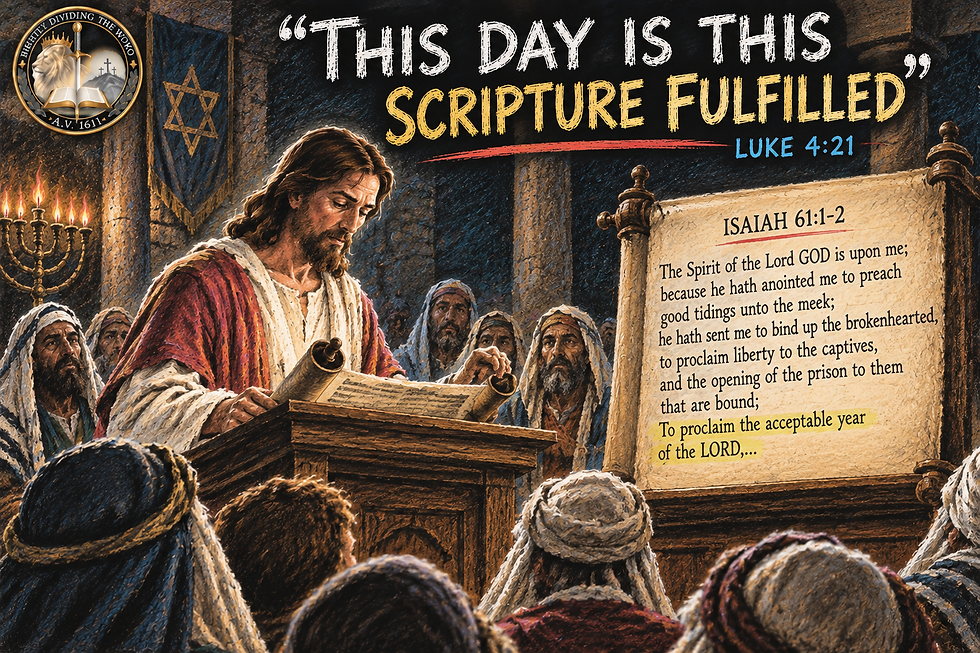
Our Lord enters the synagogue at Nazareth and reads from the prophet Isaiah:
Luke 4:16–21:
“And he came to Nazareth, where he had been brought up: and, as his custom was, he went into the synagogue on the sabbath day, and stood up for to read. And there was delivered unto him the book of the prophet Esaias. And when he had opened the book, he found the place where it was written, The Spirit of the Lord is upon me, because he hath anointed me to preach the gospel to the poor; he hath sent me to heal the brokenhearted, to preach deliverance to the captives, and recovering of sight to the blind, to set at liberty them that are bruised, To preach the acceptable year of the Lord. And he closed the book, and he gave it again to the minister, and sat down…”
Then our Lord makes this remarkable declaration:
“This day is this scripture fulfilled in your ears.”
Was it fulfilled?
Absolutely.
But notice something fascinating.
Compare what Christ read with the original prophecy:
Isaiah 61:1–2:
“The Spirit of the Lord GOD is upon me; because the LORD hath anointed me to preach good tidings unto the meek; he hath sent me to bind up the brokenhearted, to proclaim liberty to the captives, and the opening of the prison to them that are bound; To proclaim the acceptable year of the LORD, and the day of vengeance of our God…”
Christ stopped reading at:
“the acceptable year of the Lord.”
He did not continue with:
“and the day of vengeance of our God.”
Why?
Because the first portion concerned His first advent, while the vengeance that follows belongs to events associated with His second advent.
Yet Christ could still truthfully declare:
“This day is this scripture fulfilled in your ears.”
Here, then, is an important biblical principle:
A prophecy may begin to be fulfilled without every event contained within that prophecy being fulfilled at the same moment.
And I believe this provides the key to understanding Peter’s words in Acts chapter 2.
“BUT THIS IS THAT”
Peter did not say that every detail of Joel’s prophecy had been completed.
He said:
“But this is that which was spoken by the prophet Joel.”
Something Joel had prophesied was taking place before their eyes.
The Spirit had been poured out.
Supernatural manifestations were occurring.
Tongues were being spoken.
Signs were being given.
And all of this was taking place in Jerusalem, among Jews and Jewish proselytes, in connection with the nation to whom those prophetic promises belonged.
The remainder of Joel’s prophecy—the wonders in heaven, blood, fire, vapour of smoke, the darkened sun, the moon turned to blood, and the great and notable day of the Lord—could have followed.
Why didn't it?
Because Israel continued to reject the testimony being given to her.
THE KINGDOM PROGRAM HAD NOT SIMPLY DISAPPEARED
This helps explain something else that is frequently overlooked when interpreting the early chapters of Acts.
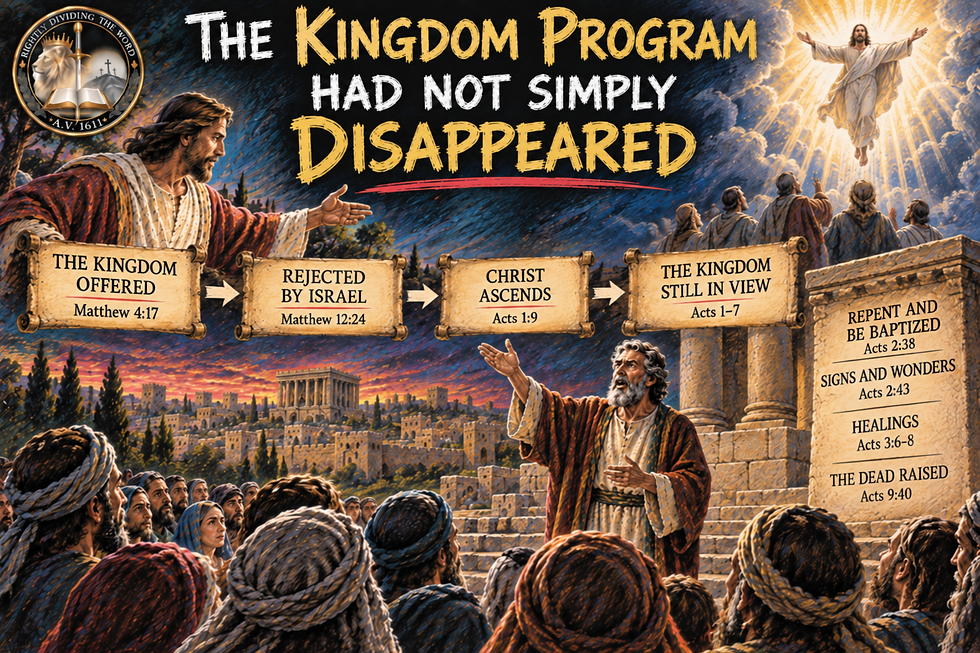
The prophetic Kingdom program did not simply vanish the moment Christ ascended into heaven.
Look at what continues after His ascension.
Peter is preaching to Jews and Jewish proselytes in Jerusalem.
His message is:
“Repent, and be baptized…”
Signs and wonders accompany the apostles.
Tongues are manifested.
Miraculous healings take place.
The dead are raised.
The supernatural signs associated with Israel continue throughout the transitional period recorded in Acts.
These things should immediately warn us against simply taking everything occurring in early Acts and applying it indiscriminately to the Church "which is His body" during the present dispensation of the grace of God.
Something distinctly Jewish and prophetic is still taking place.
And perhaps nowhere is that more dramatically demonstrated than at the death of Stephen.
STEPHEN SAW JESUS STANDING
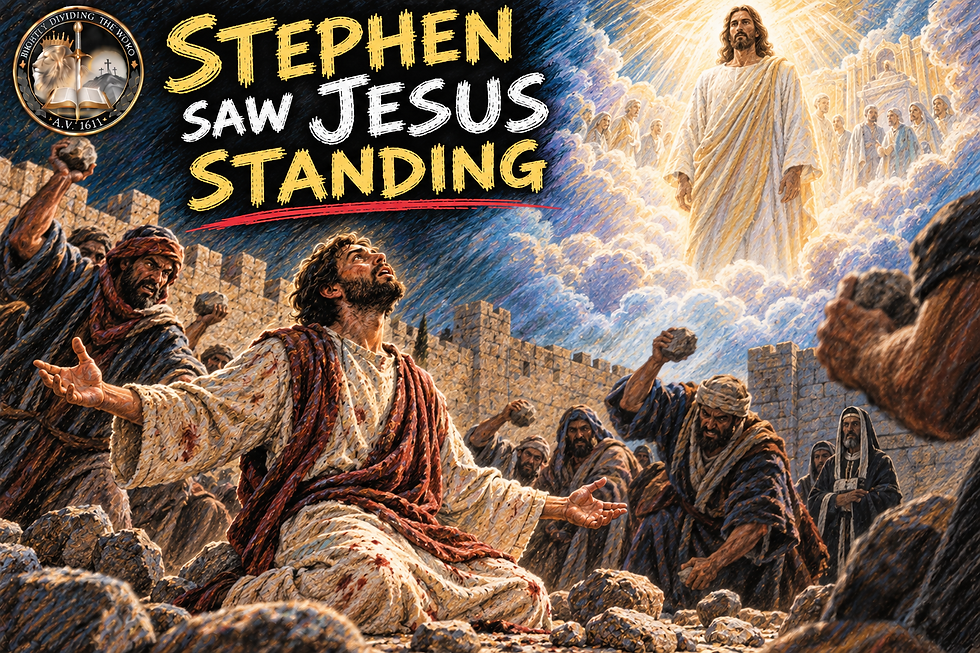
When Stephen is being stoned, Scripture records:
Acts 7:55–56:
“But he, being full of the Holy Ghost, looked up stedfastly into heaven, and saw the glory of God, and Jesus standing on the right hand of God, And said, Behold, I see the heavens opened, and the Son of man standing on the right hand of God.”
Notice carefully:
Jesus is standing.
That is significant because Mark tells us what Christ did after His ascension:
Mark 16:19:
“So then after the Lord had spoken unto them, he was received up into heaven, and sat on the right hand of God.”
He sat down.
Yet when Stephen looks into heaven, he sees the Lord standing.
Why?
I do not believe that detail is accidental.
Stephen is standing before Israel’s rulers and rehearsing the nation's long history of resisting God. He concludes by telling them:
“Ye stiffnecked and uncircumcised in heart and ears, ye do always resist the Holy Ghost…”— Acts 7:51
And as Israel once again rejects the testimony of the Holy Ghost, Stephen looks into heaven and sees the Son of man standing.
The King who had sat down is now standing.
The prophetic program could have proceeded.
Judgment could have followed.
The events Peter had quoted from Joel could have continued toward their literal completion.
But Israel rejected the testimony again.
They rejected the Father throughout their Old Testament history.
They rejected the Son during His earthly ministry.
And now, in Acts, they resist the Holy Ghost.
Stephen is murdered.
And the remainder of Joel remains unfulfilled.
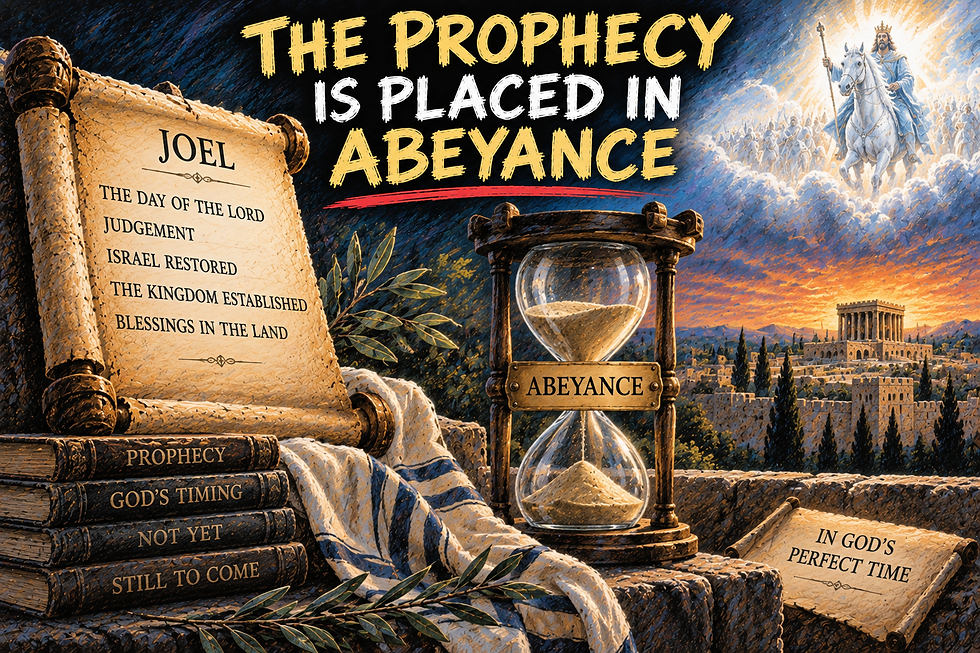
THE PROPHECY IS PLACED IN ABEYANCE
Taken collectively, I believe these passages vindicate Peter’s words on the day of Pentecost.
Peter was not confused.
He was not falsely interpreting Joel.
And the Holy Ghost did not preserve a doctrinal blunder in Acts 2 without correcting it.
“This is that” meant exactly what it said.
What was happening at Pentecost genuinely belonged to the prophetic events spoken of by Joel.
But just as our Lord could proclaim a genuine fulfillment of Isaiah 61 while stopping before the future “day of vengeance,” Peter could identify the events of Pentecost with Joel without requiring every subsequent detail of Joel’s prophecy to occur that same day.
Had Israel received the testimony being given to her, the remaining prophetic events could have followed, ultimately leading to the return of Israel’s Messiah and the establishment of His Kingdom.
But Israel did not receive it.
Consequently, the prophetic program was interrupted, and its remaining fulfillment was placed in abeyance.
The present dispensation of the grace of God intervened.
But God has not forgotten Israel.
Neither has He cancelled Joel.
What remains unfulfilled is still future, and when God resumes His dealings with Israel, every word will ultimately be fulfilled exactly as it was written.
So when Peter stood on the day of Pentecost and declared:
“BUT THIS IS THAT WHICH WAS SPOKEN BY THE PROPHET JOEL…”
perhaps the safest thing for the Bible Believer to do is simply believe him.
Not that all of Joel was fulfilled that day.
But that what they were witnessing genuinely was “that which was spoken by the prophet Joel.”
The prophecy had begun to unfold.
Israel rejected the testimony.
The program was interrupted.
But the prophecy has not been cancelled.
God will yet finish what He began.
May the grace of our Lord be with you all!


Comments