
C. T. STUDD — A LIFE SPENT FOR CHRIST

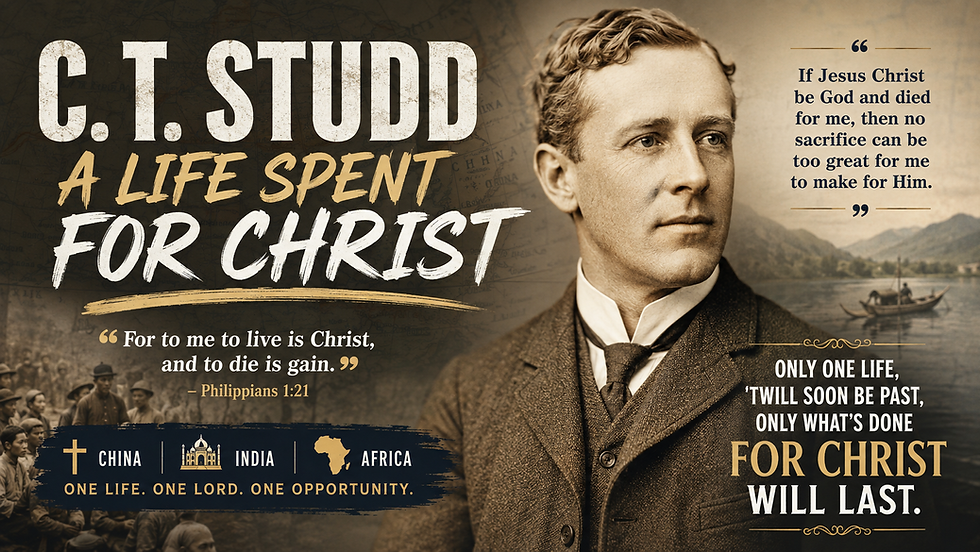
“For to me to live is Christ, and to die is gain.”— Philippians 1:21
There are some missionaries whose lives make us stop and ask ourselves a very uncomfortable question:
How much is Jesus Christ really worth to me?
For C. T. Studd, that question was not answered merely with words.
He answered it with his career.He answered it with his fortune.He answered it with his comfort.He answered it with his health.And ultimately, he answered it with his life.
Charles Thomas Studd was born in England in 1860 into a wealthy family. He had opportunities that most people of his generation could only dream about.
And he became famous.
But not initially as a preacher.
Not as a missionary.
Not as the founder of a mission.
C. T. Studd became famous playing cricket.
He was one of England's finest cricketers and played in the famous 1882 match against Australia that helped give rise to what became known as The Ashes.
He had fame.
He had ability.
He had money.
He had a future.
By the world's standards, C. T. Studd had everything a young man could want.
But God wanted C. T. Studd.
WHEN CHRIST BECAME MORE IMPORTANT THAN CRICKET
Studd had professed faith in Christ earlier in his life, but for several years cricket had become the great passion occupying his heart.
Then something happened that changed his perspective.
His brother George became seriously ill.
Suddenly, the applause of the crowds didn't seem quite so important.
The trophies didn't seem quite so valuable.
The fame didn't seem quite so permanent.
Studd began thinking about eternity.
He later reflected on how quickly the things of this world lose their importance when a man comes face-to-face with death.
Jesus said:
“For what shall it profit a man, if he shall gain the whole world, and lose his own soul?”— Mark 8:36
Studd began to understand something every Christian eventually must learn:
You can spend your whole life succeeding at something that will not matter in eternity.
Cricket wasn't sinful.
Success wasn't sinful.
Being talented wasn't sinful.
But Studd realized that Jesus Christ deserved first place.
And once Christ had his heart, everything else began to look different.
1. HE WALKED AWAY FROM WHAT THE WORLD CALLED SUCCESS

In 1885, C. T. Studd did something that shocked many people.
He joined six other young men from Cambridge who were preparing to go to China with Hudson Taylor's China Inland Mission.
They became known as the Cambridge Seven.
These were educated, capable young men with promising futures.
Yet they were willing to leave England and carry the Gospel to China.
Imagine what people must have thought about Studd.
You're throwing your career away.
You're wasting your talent.
You're giving up your future.
But heaven measures success differently than earth does.
Paul said:
“But what things were gain to me, those I counted loss for Christ.”— Philippians 3:7
Studd had discovered something Paul discovered centuries earlier:
When Christ becomes the treasure, everything else becomes negotiable.
The world looked at what Studd was leaving.
Studd looked at Who he was following.
There is a tremendous difference.
Sometimes we talk about what missionaries sacrifice.
They sacrifice their country.
Their family.
Their comfort.
Their possessions.
Their careers.
But perhaps the better question is:
Can anything truly be called a sacrifice when it is given to the One who gave everything for us?
2. HE DIDN'T JUST GIVE GOD HIS LIFE — HE GAVE HIM HIS MONEY

A few years later, Studd inherited a considerable fortune.
He could have lived comfortably for the rest of his life.
Instead, he began giving it away to Christian ministries and Gospel work.
He wanted his treasure invested somewhere thieves couldn't steal it and death couldn't take it.
Jesus said:
“Lay not up for yourselves treasures upon earth, where moth and rust doth corrupt, and where thieves break through and steal:”
“But lay up for yourselves treasures in heaven...”— Matthew 6:19–20
Studd understood something we easily forget:
Everything we possess has an expiration date.
Our houses.
Our bank accounts.
Our possessions.
Our businesses.
Our investments.
Eventually we leave every bit of it behind.
But what is invested in eternity lasts.
Studd famously expressed the conviction:
“If Jesus Christ be God and died for me, then no sacrifice can be too great for me to make for Him.”
That wasn't a slogan hanging on his wall.
He lived it.
3. CHINA WASN'T ENOUGH

C. T. Studd served in China.
Later he served in India.
Many people would have considered that enough.
Surely he had done his part.
Surely he had earned the right to settle down.
Surely someone younger could go now.
But God wasn't finished with him.
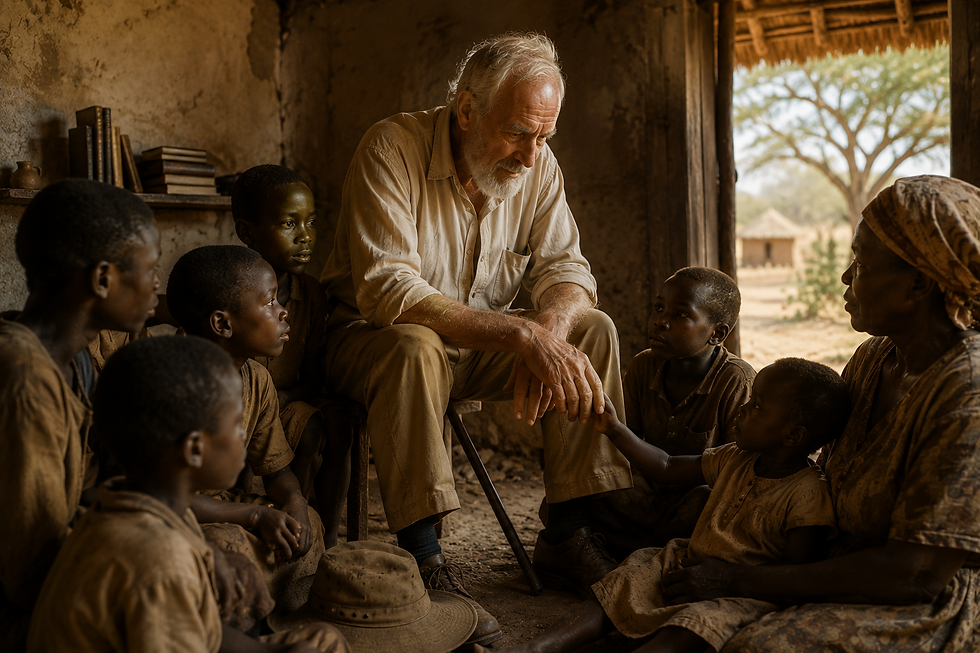
Studd learned about vast regions of Africa where millions had little opportunity to hear the Gospel.
And once again, his heart was stirred.
There was one major problem.
His health was poor.
People warned him against going.
Even those close to him questioned the wisdom of it.
But Studd could not escape the burden.
There were people who needed the Gospel.
And he believed somebody needed to go.
Paul wrote:
“Yea, so have I strived to preach the gospel, not where Christ was named...”— Romans 15:20
Studd eventually went to Africa and began the work that developed into the Heart of Africa Mission, later known as the Worldwide Evangelisation Crusade.
He was no longer the young cricket star who had sailed for China.
He was older.
His body was weaker.
His health was failing.
But the fire still burned.
4. HE WANTED TO GO WHERE CHRIST WAS NOT KNOWN

One of Studd's best-known writings contains the line:
“Some wish to live within the sound of church or chapel bell; I want to run a rescue shop within a yard of hell.”
That sentence captures something desperately needed in Christianity.
We naturally gravitate toward comfort.
Safe churches.
Safe communities.
Safe ministries.
Safe Christianity.
But missionary Christianity has never been built around safety.
Jesus said:
“Go ye into all the world, and preach the gospel to every creature.”— Mark 16:15
GO.
That little word has moved missionaries across oceans.
It has carried Bibles across borders.
It has sent preachers into jungles.
It has put Gospel tracts into countless hands.
It has planted churches where there were none.
The Great Commission was never:
Stay where it is comfortable.
It was:
GO.
5. HE REFUSED TO WASTE HIS ONE LIFE
Perhaps no words associated with C. T. Studd are remembered more than these:
“Only one life, ’twill soon be past,Only what’s done for Christ will last.”
Read that again.
Only one life.
We don't get another one.
There is no rehearsal.
There is no second opportunity to come back and live our lives for Christ.
James says:
“For what is your life? It is even a vapour, that appeareth for a little time, and then vanisheth away.”— James 4:14
Our lives feel long while we're living them.
But eternity will reveal how short they really were.
C. T. Studd had been given fame.
He had been given money.
He had been given ability.
But eventually he realized that the greatest thing he could possibly do with those things was:
GIVE THEM BACK TO GOD.
THE CRICKET BAT WILL EVENTUALLY BE PUT DOWN
There is something beautiful about Studd's story.
The young man who once stood before cheering crowds eventually found himself far from England, labouring for Christ in Africa.
The applause was gone.
The fame was behind him.
The comfortable English life was gone.
His body was wearing out.
But he had something infinitely better.
He had spent his life for Jesus Christ.
Paul could say near the end of his life:
“I have fought a good fight, I have finished my course, I have kept the faith:”— 2 Timothy 4:7
That's the finish line that matters.
Not:
I became wealthy.
Not:
I became famous.
Not:
Everybody knew my name.
But:
I finished the course God gave me.
THE MISSIONARY LESSON
C. T. Studd's life leaves us with a question.
What are we saving our lives for?
Maybe God isn't asking you to go to China.
Maybe He isn't asking you to go to India.
Maybe He isn't asking you to go to Africa.
But if you belong to Jesus Christ...
Your life already belongs to Him.
Paul wrote:
“And that he died for all, that they which live should not henceforth live unto themselves, but unto him which died for them, and rose again.”— 2 Corinthians 5:15
That is missionary Christianity.
Not living unto ourselves.
Our time belongs to Him.
Our money belongs to Him.
Our abilities belong to Him.
Our plans belong to Him.
Our future belongs to Him.
Our lives belong to Him.
And perhaps the greatest tragedy for a Christian would not be to die young on a mission field.
Perhaps the greater tragedy would be to live a long, comfortable life...
and spend it on things that do not matter in eternity.
C. T. Studd lived 70 years.
The cricket crowds eventually stopped cheering.
The newspapers moved on to other stars.
Another generation of athletes took the field.
But more than a century later, the influence of a life surrendered to Jesus Christ continues.
Why?
Because:
“Only one life, ’twill soon be past,Only what’s done for Christ will last.”
So wherever God has placed us...
Whatever He has placed in our hands...
However many years He gives us...
May we be able to say with Paul:
“For to me to live is Christ, and to die is gain.”— Philippians 1:21
ONE LIFE.
ONE LORD.
ONE OPPORTUNITY TO SPEND IT FOR HIS GLORY.
Don't waste it.



Comments