
MISSIONARY SPOTLIGHT #7 — THE MORAVIANS: WHEN THE GOSPEL WAS WORTH EVERYTHING

When the Gospel Was Worth Everything
“For the love of Christ constraineth us...”2 Corinthians 5:14

In the summer of 1727, in a small settlement in Saxony called Herrnhut, something was happening that few people outside the community would have considered important.
Herrnhut was not a great city. It possessed no magnificent cathedral, no famous university, and no powerful missionary society. It was a small community established on the estate of Count Nicolaus Ludwig von Zinzendorf, where religious refugees had been permitted to settle.
Many of them came from a heritage of persecution. Their spiritual ancestors had suffered because they refused to surrender convictions for which previous generations had paid dearly.
Yet persecution had not made the little community immune to division.
Differences had arisen among them. Personal disagreements, theological disputes, and competing opinions threatened the fellowship. The people who had gathered at Herrnhut seeking refuge from trouble outside soon discovered that trouble could arise just as easily from within.
Zinzendorf became deeply concerned.
He visited homes. He spoke with families. He pleaded for reconciliation. The people began seeking God together, and during the summer of 1727 the atmosphere in the settlement began to change.
Then came August 13.
During a communion service at the nearby church in Berthelsdorf, the congregation experienced what they would remember as an extraordinary visitation of God. Old grievances lost their importance. Divisions began to disappear. Men and women who had been separated by disagreement found themselves united by something greater than themselves.
But what followed is perhaps more remarkable than what happened that day.
They began to pray.
On August 27, an organized prayer watch was established. Men and women divided the hours among themselves so that throughout the day and night someone from the community would be before God in prayer.
It is difficult, nearly three hundred years later, to appreciate the simplicity of it.
There were no crowds watching.
No newspapers reporting it.
No one could have known what would eventually come from it.
Night settled over Herrnhut. Lamps were extinguished. Children slept. Tradesmen rested from their work.
But somewhere in the little settlement, a light remained burning.
Someone was praying.
When that person's appointed time ended, another took their place.
Then another.
Morning came, and the prayers continued.
People returned to their work, but the prayer watch continued.
Another evening came.
Another night.
Another morning.
The days became weeks. The weeks became months. The months became years.
Through successive generations and expanding Moravian communities, that organized intercession became associated with a prayer watch lasting roughly a century.
While Herrnhut prayed, however, the people's attention was increasingly drawn toward a world far beyond their little settlement.
They were about to discover that prayer has a way of making distant people seem very near.
A Voice from St. Thomas
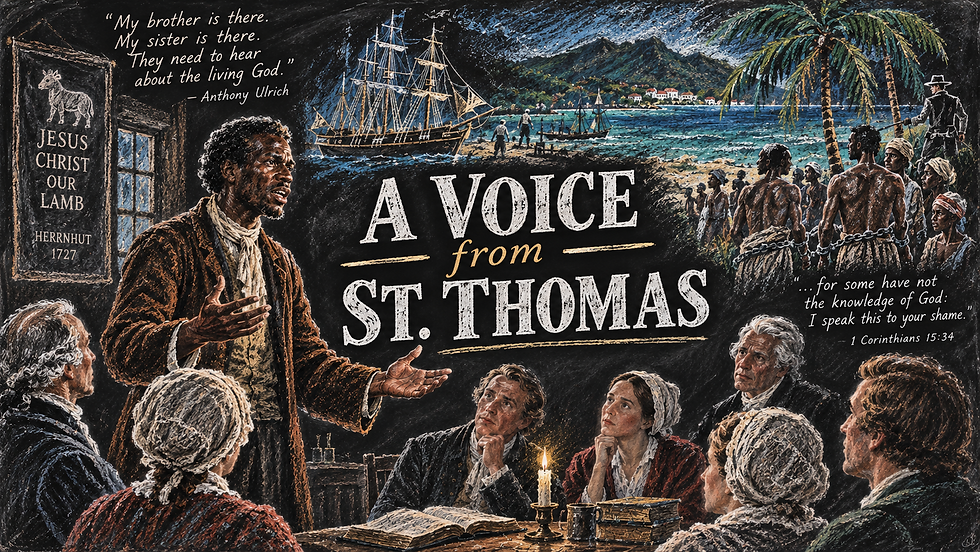
In 1731, Count Zinzendorf visited the Danish royal court.
There he encountered an African man named Anthony Ulrich, who had come from the Danish island of St. Thomas in the West Indies.
Anthony had a story to tell.
And once that story reached Herrnhut, it would help change the direction of the little community forever.
Anthony spoke about the enslaved Africans of St. Thomas.
He knew them.
They were his people.
He spoke particularly of members of his own family who remained in bondage—his brother Abraham and his sister Anna.
They were not statistics.
They were not numbers on a missionary report.
They were a brother and a sister.
They were real people living under slavery thousands of miles away.
Anthony spoke of their desire to hear about the living God.
Eventually he travelled to Herrnhut and told the congregation what he had already told Zinzendorf.
Imagine sitting in that room.
Until that moment, St. Thomas might as well have been another world.
Most of those listening would never see it.
They would never walk its beaches.
They would never see its plantations.
They would never meet the thousands of enslaved Africans working beneath the Caribbean sun.
But now one of those men stood before them.
And he was telling them:
My family is there.
My people are there.
They need to hear.
For one young potter named Leonhard Dober, the words would not go away.
That night he could not sleep.
He lay awake thinking about people he had never met.
Somewhere beyond Germany.
Beyond Denmark.
Beyond the Atlantic Ocean.
There were people who did not know Christ.
The words Paul would write centuries earlier seem almost to hover over that sleepless night:
“Awake to righteousness, and sin not; for some have not the knowledge of God: I speak this to your shame.”1 Corinthians 15:34
Dober knew.
And once he knew, he could no longer pretend that he did not.
The Potter and the Carpenter
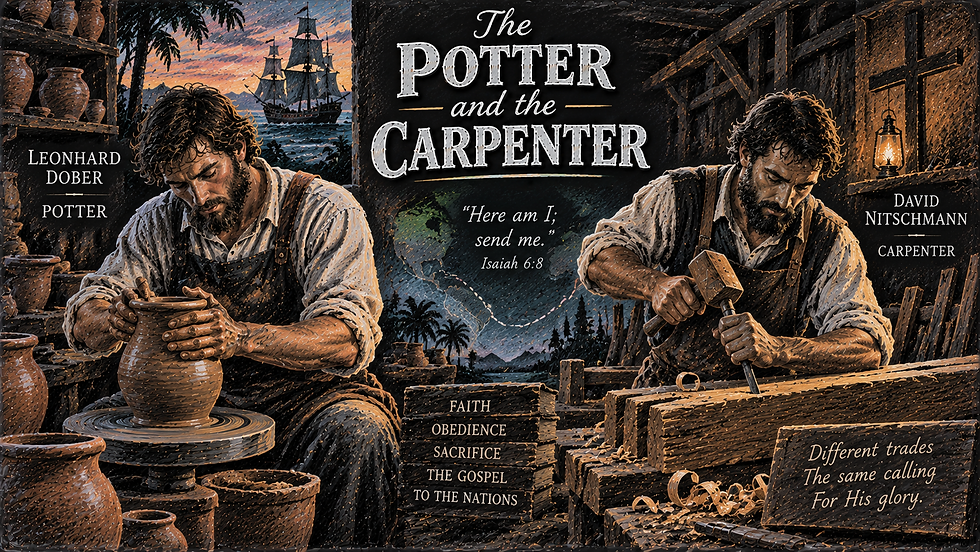
Leonhard Dober was twenty-six years old when he eventually left for the West Indies.
He was a potter by trade.
There was nothing about his occupation that suggested his name would still be remembered nearly three centuries later.
Another man, David Nitschmann, was a carpenter.
He was thirty-five.
Two tradesmen.
A potter and a carpenter.
No missionary degrees.
No great financial backing.
No elaborate organization preparing the way before them.
Only an increasingly settled conviction that somebody ought to go.
At first, Dober was not the only volunteer. Others at Herrnhut felt the same burden.
But the proposal seemed almost unreasonable.
The West Indies were far away.
The climate was dangerous to Europeans.
The people they hoped to reach were enslaved.
The plantation system was not designed to make evangelistic work among the slaves convenient.
There were questions about how missionaries could even support themselves.
The Brethren hesitated.
Zinzendorf himself hesitated.
Was this zeal—or presumption?
Was Dober truly being sent of God?
According to the early Moravian histories, the matter was eventually submitted to the Moravian practice of drawing a lot.
Dober was willing.
He believed the matter was already settled in his own heart, but he agreed for the sake of the congregation.
The result was interpreted simply:
Let the young man go.
Dober would go.
David Nitschmann would accompany him and help establish the work.
A potter and a carpenter were going to cross the Atlantic.
Three O'Clock in the Morning
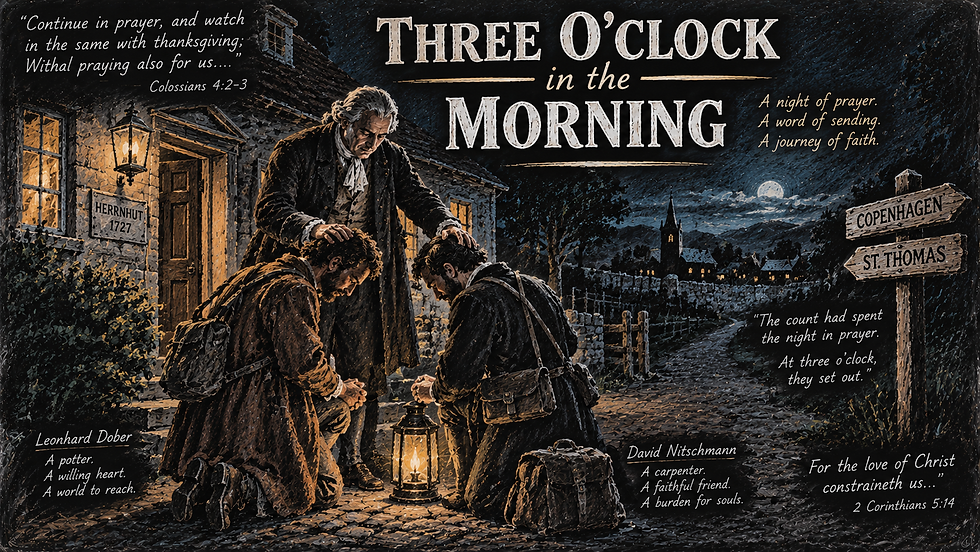
The morning of their departure came in August 1732.
It was still dark.
At about three o'clock, Dober and Nitschmann stood outside Zinzendorf's house.
The Count had spent the night in prayer.
There is something fitting about that scene.
Before the missionaries walked toward the mission field—
someone had been praying.
Before they crossed the Atlantic—
someone had been praying.
Before they ever preached to an enslaved African—
someone had been praying.
Zinzendorf travelled with them part of the way.
Outside Bautzen, they stopped.
There on the roadside, the little party knelt.
No crowd.
No missionary conference.
No photographers.
No farewell banquet.
A quiet road.
A few men.
A prayer.
Zinzendorf laid his hands upon Dober and blessed him.
Then they separated.
The two missionaries continued toward Copenhagen.
They had very little.
A later Moravian account records that the two men were given only three silver coins to share and were told to find work along the journey.
They were not travelling as gentlemen.
They were tradesmen.
If they needed money, they could work.
Nitschmann had his skill as a carpenter.
Dober had learned pottery from his father.
Their hands would help carry them toward the people they wanted to reach.
“A Fool's Errand”
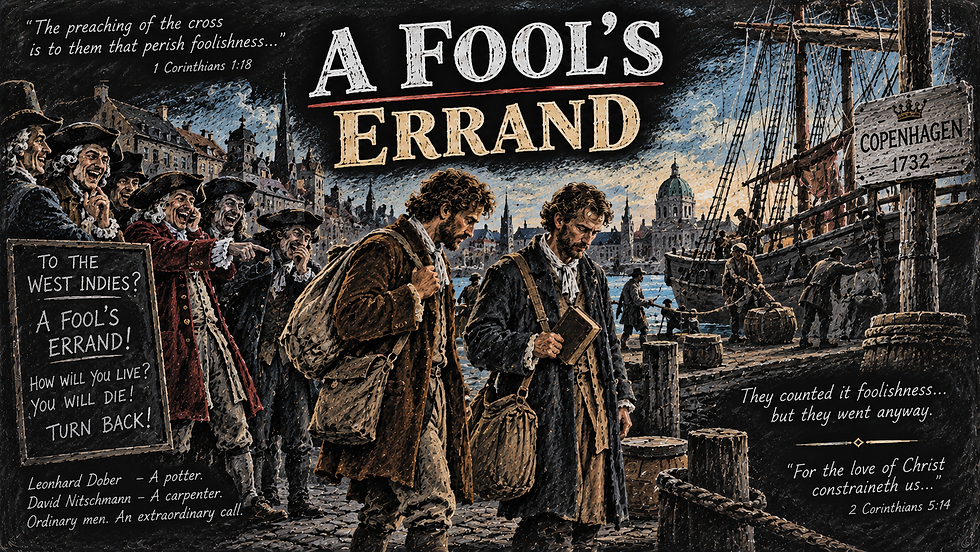
Copenhagen did not greet their missionary plans with enthusiasm.
People heard what they intended to do and considered the entire enterprise foolish.
Some mocked them.
Others tried to reason with them.
How would they live?
How would they reach the slaves?
What would they eat?
What would happen when their money was gone?
Did they understand the climate?
Did they realize they might die?
Even finding a captain willing to take them became difficult.
The obstacles were not imaginary.
They were formidable.
Yet the two men remained.
Doors eventually began to open.
People who had first heard about their strange mission began helping them. Money was given. A Bible was provided. Practical assistance came from unexpected places.
Finally a ship was found.
On October 8, 1732, Dober and Nitschmann boarded the vessel that would carry them toward St. Thomas.
Imagine standing on that deck.
The ropes are drawn aboard.
Sails rise.
The ship begins to move.
Copenhagen slowly recedes.
Then Denmark.
Then Europe itself.
Everything familiar begins disappearing behind them.
There would be no flight home next week.
No telephone call to Herrnhut.
No message sent in seconds.
Only ocean.
And somewhere beyond that ocean—
Anthony's people.
When the Shoreline Disappeared

The voyage lasted approximately nine weeks.
For days there was nothing but sea.
Then more sea.
A man can make a courageous decision while surrounded by friends.
It is another thing to live with that decision when the shoreline has disappeared.
There must have been moments when the immensity of what they had undertaken became painfully clear.
They were two ordinary men aboard a wooden ship crossing the Atlantic toward a slave colony.
They did not know what reception awaited them.
They did not know how long they would remain.
They could not know what their decision would eventually begin.
Perhaps they remembered Herrnhut.
Perhaps they pictured the little community at prayer.
Perhaps somewhere in Saxony, while waves struck the side of their ship, someone was awake in the middle of the night praying for them.
The ship continued west.
Then, in December 1732, land appeared.
St. Thomas.
The island Anthony had described was no longer a story.
It stood before them.
More than fifty plantations dotted the island, worked by thousands of enslaved Africans.
Dober and Nitschmann had finally reached the people for whom they had crossed an ocean.
The Story They Never Needed
It is here that history and legend have become intertwined.
For generations, one of the most dramatic stories in missionary preaching has been repeated about these two men.
It is said that Dober and Nitschmann discovered they could reach the enslaved Africans only by becoming slaves themselves, and so they sold themselves into slavery.
It is an unforgettable story.
But the historical evidence does not support the claim that they actually became slaves.
The truth needs no embellishment.
They had already left home.
They had already walked away from ordinary lives.
They had already crossed Europe with almost nothing.
They had already endured ridicule.
They had already crossed the Atlantic.
They were prepared to work with their hands and live among people whom European society regarded as beneath them.
Their willingness to sacrifice was real.
The legend is unnecessary.
The truth is powerful enough.
Then Others Came
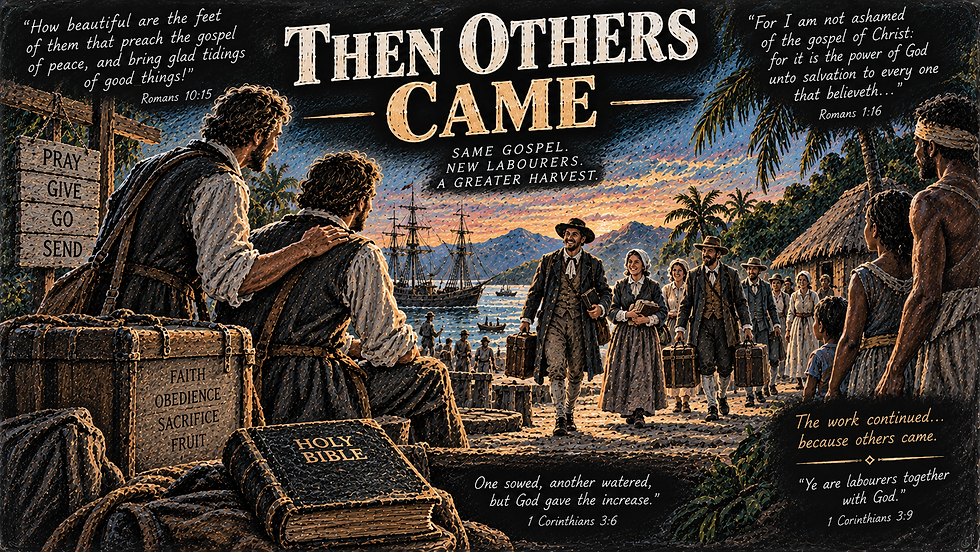
Dober and Nitschmann were only the beginning.
The news travelled back to Herrnhut.
And something extraordinary happened.
Others volunteered.
Within ten years of hearing Anthony's account, that little community had sent missionaries toward Greenland, Lapland, Georgia, the Guinea Coast, South Africa, Ceylon, Dutch Guiana, Algiers, St. Croix, Pennsylvania, New York and other fields.
Ships began carrying Moravians outward in multiple directions.
But the expansion came at a terrible price.
In 1734, another company of Moravians travelled to the West Indies, with St. Croix becoming a particular focus.
The climate proved devastating.
Disease struck.
One died.
Then another.
Then another.
Within about a year, ten members of one group had died.
News of the deaths travelled back across the Atlantic.
Herrnhut now knew what the mission field might cost.
The question was no longer hypothetical.
They had sent people out.
Some of them were dead.
So what would Herrnhut do?
Stop?
Surely ten graves were enough.
Surely God could not expect more.
Surely prudence demanded that no one else volunteer.
But more volunteers came.
Another group was sent.
And again disease took its toll.
Several more died. Historical accounts record extraordinarily high mortality among these early West Indian workers.
Imagine receiving that news in Herrnhut.
Another missionary dead.
Another grave thousands of miles from home.
Another family grieving.
Another empty chair.
And still someone stepped forward.
Not because life was cheap to them.
But because Christ was precious.
Paul had written:
“And I will very gladly spend and be spent for you...”2 Corinthians 12:15
They were learning what spent could mean.
The Mission Did Not Die With the Missionaries

Death did not end the work.
Others continued.
Frederick Martin was among those who carried the work forward on St. Thomas.
Opposition came not only from climate and disease but also from men.
Missionary work among enslaved Africans threatened interests within plantation society. Some slaveholders resented the preaching. Those who attended meetings could face punishment.
Missionaries themselves encountered hostility.
Martin was eventually imprisoned.
Yet the gospel continued to spread.
The missionaries spoke to enslaved people personally.
One conversation.
One soul.
One gathering at a time.
The work that had begun with Anthony telling Christians in Europe about his family was taking root in the Caribbean.
The Moravians also made education among enslaved people a significant part of their West Indian work.
The graves had not silenced the gospel.
If anything, they had demonstrated that these people truly believed what they preached.
Christ was worth living for.
And Christ was worth dying for.
The Fire Kept Spreading
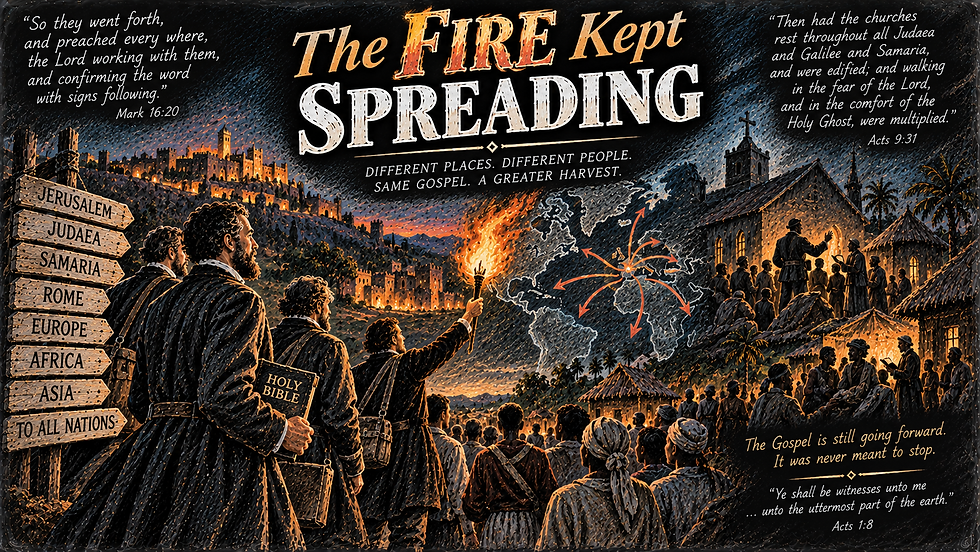
While missionaries struggled in the Caribbean, other Moravians went elsewhere.
The names of the mission fields began to sound like a geography lesson.
Greenland.
Africa.
Suriname.
North America.
Ceylon.
Places separated by oceans, climates, cultures and languages.
Yet behind the different destinations stood the same conviction.
“For the love of Christ constraineth us.”
The missionaries were not all great preachers.
Many were ordinary labourers.
They learned trades.
They worked.
They lived among the people.
They learned languages.
They buried friends.
Sometimes they buried wives.
Sometimes they buried children.
Sometimes the missionary himself was buried and another came to take his place.
Back in Herrnhut, the prayers continued.
While ships disappeared over the horizon—
someone prayed.
While missionaries struggled to learn languages—
someone prayed.
While disease entered a missionary home—
someone prayed.
While a preacher stood before people hearing the gospel for the first time—
someone prayed.
Some crossed oceans.
Others never left Saxony.
But both were part of the work.
More Than a Century Later
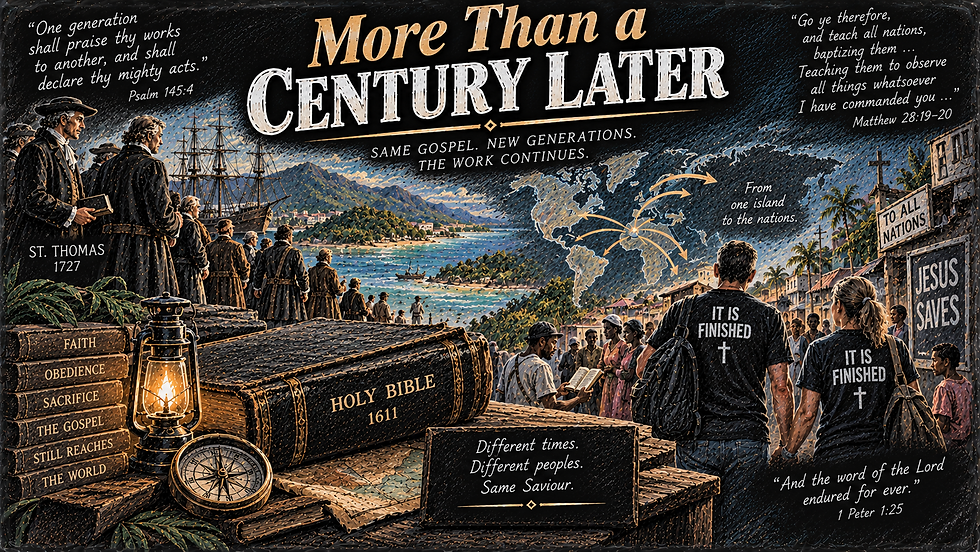
More than a hundred years passed.
The first generation was gone.
Dober died in 1766.
Nitschmann was gone.
Zinzendorf was gone.
The men and women who had begun the prayer watch were gone.
But the missionary spirit they had helped nurture did not disappear.
In 1865, a German noblewoman, Baroness Auguste von Keffenbrinck-Ascheraden, visited Jerusalem and was deeply affected by the sight of people suffering from leprosy living in miserable conditions outside the city.
She returned to Europe determined that something should be done.
Money was raised.
Land was obtained.
A home was built.
But a building was not enough.
Someone had to live there.
Someone had to care for the patients.
Someone had to walk through the door.
The Baroness turned to the Moravians.
There was a reason.
The Moravian Church already had experience caring for people with leprosy in South Africa.
The call eventually came to Friedrich and Magdalena Tappe, a married Moravian couple who had previously served for years in Labrador.
They accepted.
In May 1867, the Tappes arrived in Jerusalem.
On May 30, the new home was dedicated.
But there was a problem.
The people it had been built to help did not trust it.
Many of the sufferers were Muslims. They feared the Christian institution. They feared losing their independence. They feared that receiving care might come with religious pressure.
At the dedication, about fifty people suffering from leprosy were invited.
Only four came.
And even they did not immediately remain.
The building was ready.
The workers were ready.
But the beds were largely empty.
So the Tappes waited.
They served.
They built trust.
At the end of August, a young man suffering from leprosy came from Gaza with his mother.
They hesitated.
They left.
Others gradually came.
By the end of the year, patients were living in the home.
Within a few years, the problem had completely reversed.
The home was becoming too small.
By 1872, people sometimes had to be turned away because there was not enough room.
The people who had once feared walking through the doors had discovered something inside.
They had found people willing to care for them.
Jesus' Help
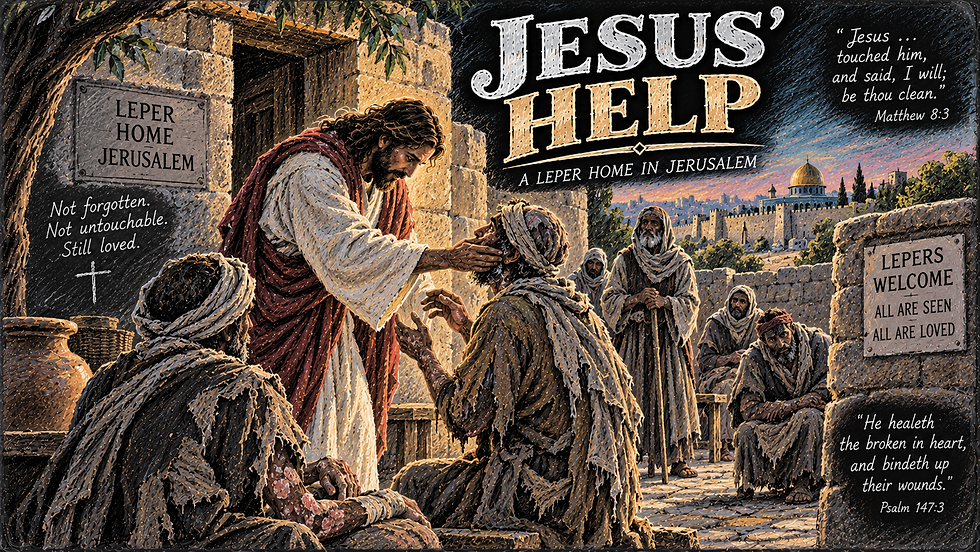
Eventually a larger home became necessary.
In 1881, the worldwide Moravian Church formally assumed responsibility for the work.
Plans were made for a larger institution.
In 1887, the new building was dedicated.
Its name was:
Jesus Hilfe.
Jesus' Help.
There is something almost perfect about the simplicity of that name.
Not the Moravians' help.
Not man's help.
Jesus' Help.
Behind those walls lived men, women and children suffering from a disease that caused much of society to keep its distance.
But Moravian workers entered.
They prepared food.
They washed.
They nursed.
They dressed wounds.
They lived near the people others feared.
They cared for people of different religious backgrounds without making acceptance of their care dependent upon conversion. And as opportunities arose, they spoke to them about Christ.
They did not merely preach at suffering people.
They lived among them.
The same missionary spirit that had once looked across an ocean and seen enslaved Africans now looked through the gates of a leprosy home and saw souls.
The circumstances had changed.
The principle had not.
“For the love of Christ constraineth us.”
Ordinary People
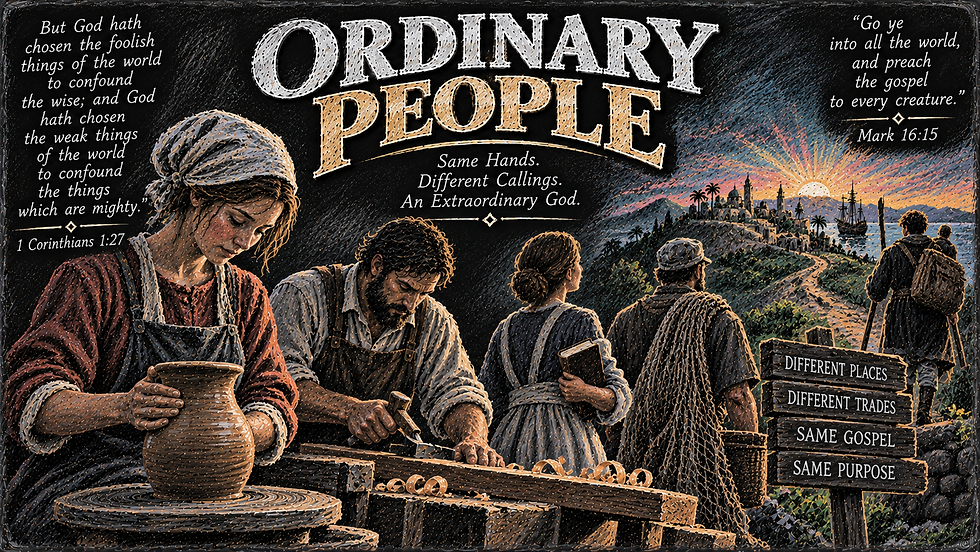
There is a danger in telling stories like these.
We turn the people in them into heroes.
Then we place the heroes on a pedestal so high that we no longer feel any obligation to resemble them.
But Leonhard Dober was a potter.
David Nitschmann was a carpenter.
Friedrich and Magdalena Tappe were a husband and wife willing to go where help was needed.
The believers maintaining the prayer watch at Herrnhut had jobs.
Children.
Meals.
Bills.
Responsibilities.
Weaknesses.
Disagreements.
They were ordinary people.
What distinguished them was not that they considered their lives worthless.
They had simply discovered something they believed was worth more than their comfort.
Paul said:
“But none of these things move me, neither count I my life dear unto myself...”Acts 20:24
And again:
“And I will very gladly spend and be spent for you...”2 Corinthians 12:15
Spend and be spent.
Perhaps no words better describe their story.
A candle burning at Herrnhut.
A potter unable to sleep because people across an ocean did not know Christ.
A carpenter walking beside him toward Copenhagen.
Three silver coins shared between two missionaries.
A ship disappearing over the horizon.
Ten graves in the Caribbean.
Then more volunteers.
A husband and wife walking through the doors of a home for people suffering from leprosy.
Lives being spent.
Not wasted.
Spent.
There is a difference.
Something wasted is thrown away for nothing.
Something spent is given in exchange for something considered valuable.
The Moravians believed Jesus Christ was worth spending their lives for.
The Lamb Was Worthy
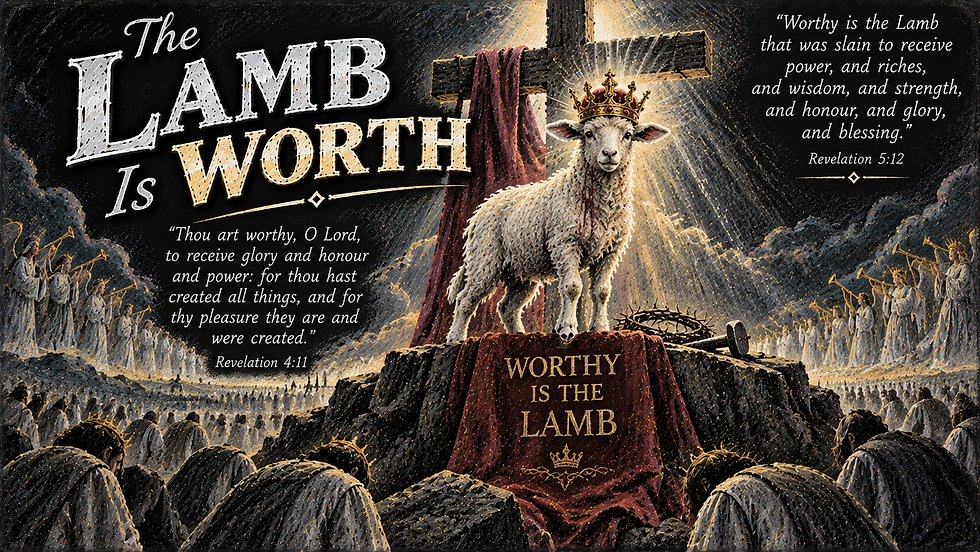
A saying eventually became inseparably associated with the Moravian missionary movement:
“May the Lamb that was slain receive the reward of His suffering.”
Like some other details in the Moravian story, the precise history surrounding the wording has been embellished in later retellings.
But the conviction expressed by it was unmistakably theirs.
The Lamb was worthy.
John heard heaven proclaim:
“Worthy is the Lamb that was slain...”Revelation 5:12
Why would a potter leave home?
Why would a carpenter cross an ocean?
Why would another volunteer after hearing that the previous missionary had died?
Why would a husband and wife enter a home filled with people suffering from leprosy?
Why pray through the night?
Why give?
Why go?
Because the Lamb was worthy.
They were not attempting to repay Calvary.
No man could.
They were responding to it.
Christ had died for our sins according to the Scriptures.
He was buried.
He rose again the third day according to the Scriptures.
They had received the good news.
And that meant they now possessed something that others desperately needed.
Which brings us to another story.
A much older one.
“We Do Not Well”
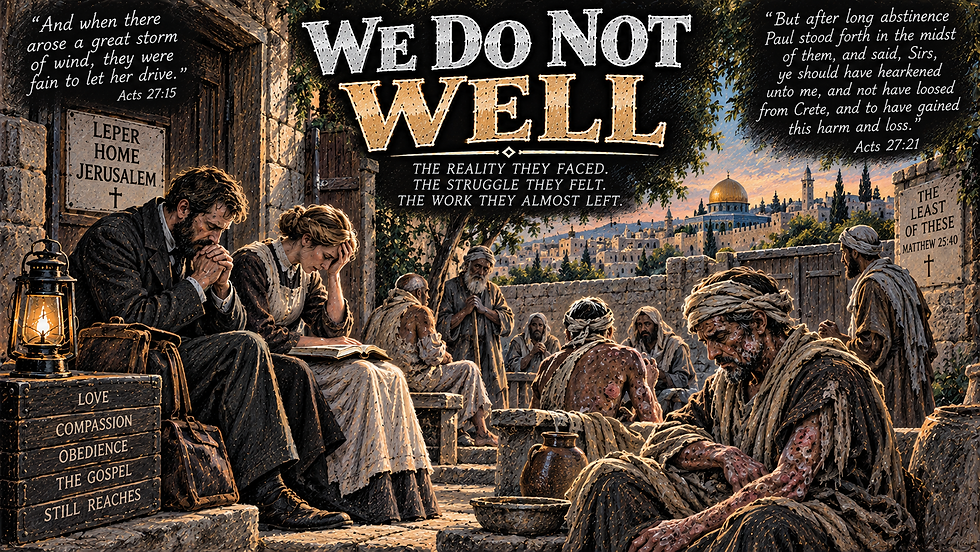
Centuries before Herrnhut, before St. Thomas, before the first Moravian missionary ever boarded a ship, four desperate men sat outside a starving city.
The city was Samaria.
The Syrian army had surrounded it.
Inside the walls, famine had become horrifying.
There was no food.
No escape.
No hope.
Outside the gate sat four leprous men.
They reasoned among themselves that they had nothing to lose.
If they remained where they were, they would die.
If they entered the starving city, they would die.
Perhaps the Syrians would spare them.
So as evening approached, the four men walked toward the enemy camp.
They expected soldiers.
Instead—
silence.
They entered the outer part of the camp.
No guards.
No voices.
No army.
God had caused the Syrians to hear the sound of chariots and horses and a great host. Convinced that another army was approaching, they had fled.
And they had left everything behind.
The four starving men entered a tent.
There was food.
They ate.
There was drink.
They drank.
There was silver.
Gold.
Clothing.
They carried some of it away and hid it.
Then they entered another tent.
More food.
More treasure.
For men who had expected to die that evening, it must have seemed unbelievable.
But then something happened.
One of them stopped.
Perhaps he looked back toward Samaria.
Behind those walls, people were still starving.
Children were hungry.
Families were desperate.
People were dying.
And these four men knew something the people inside the city did not know.
The enemy was gone.
Food was available.
Deliverance had come.
They had good news.
And they were keeping it to themselves.
Then they said one to another:
“We do not well: this day is a day of good tidings, and we hold our peace...”2 Kings 7:9
And then came the warning:
“...if we tarry till the morning light, some mischief will come upon us...”
So they went.
They told the city.
Perhaps there is no better picture with which to end the Moravian story.
We were the starving ones.
We were without hope.
We were without Christ.
Then somebody told us the good news.
Christ died for our sins according to the Scriptures.
He was buried.
He rose again the third day according to the Scriptures.
We discovered that the enemy had been defeated.
We discovered the Bread of Life.
We discovered riches in Christ we could never have purchased for ourselves.
And now we sit surrounded by abundance while outside there are people who do not know.
Paul says:
“...for some have not the knowledge of God: I speak this to your shame.”1 Corinthians 15:34
The four lepers looked toward Samaria and realized:
We cannot keep this to ourselves.
Leonhard Dober heard about enslaved people on St. Thomas and realized:
We cannot keep this to ourselves.
David Nitschmann went with him.
Others followed.
When ten died, more volunteered.
When people suffering from leprosy in Jerusalem needed someone willing to enter their world, Friedrich and Magdalena Tappe went.
Different centuries.
Different circumstances.
But the question remains hauntingly similar.
We have good tidings.
And others are still starving without them.
Nearly three hundred years have passed since a potter and a carpenter watched Europe disappear behind their ship.
The Atlantic can now be crossed in hours instead of weeks.
A message can travel around the world in seconds.
We possess printing presses, airplanes, automobiles, telephones, radio, video, and the internet.
The Moravians possessed almost none of those things.
But they possessed the gospel.
And they possessed a willingness to be spent.
Perhaps our generation's greatest missionary problem is not that we lack the means.
Perhaps we have more means than any generation before us.
The question is whether we possess their burden.
Paul's words have not aged:
“Awake to righteousness, and sin not; for some have not the knowledge of God: I speak this to your shame.”
Some still have not the knowledge of God.
Somebody told the Moravians.
And they went.
Somebody told us.
What will we do?
The four lepers outside Samaria finally understood:
“We do not well: this day is a day of good tidings, and we hold our peace.”
May God keep us from doing the same.
Long ago, a light burned through the night in a little settlement called Herrnhut.
Someone was praying.
Then someone went.
Then another.
Then another.
Ships began disappearing over the horizon.
Graves began appearing on foreign soil.
Still others went.
More than a century later, another generation opened the doors of a home in Jerusalem and walked toward people everyone else feared.
Different generations.
Different countries.
Different dangers.
But the same Christ.
The same gospel.
The same good tidings.
And over all of it stands one great conviction:
“Worthy is the Lamb that was slain...”
Some have not the knowledge of God.
We have good tidings.
We do not well if we hold our peace.
May the Lamb that was slain receive the reward of His suffering.


Comments